

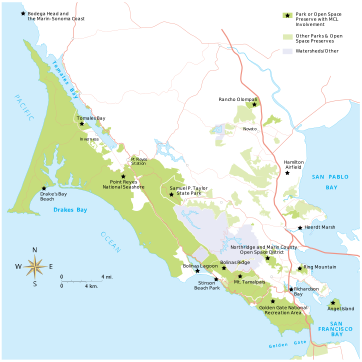
Tomales Bay State Park
MCL contributed funds and thousands of volunteer hours over a period of 10 years to enable five sandy beaches and acres of Bishop Pine forest on Tomales Bay to eventually become a State Park in 1951.
Bodega Head and the Marin-Sonoma Coast
MCL worked with many allies in the early 1960s to defeat a proposal to construct a nuclear power plant on Bodega Head, and a decade later led a campaign to oppose opening up the Marin-Sonoma coast to off-shore oil drilling.
Point Reyes National Seashore
Provided years-long support leading up to signing of Point Reyes as a National Seashore in 1962 and in contributing financial and other support for Save Our Seashore campaign to secure congressional funding for acquisition of farmlands within the Seashore boundaries in 1969.
Drakes Bay Beach
MCL, in its very first effort to acquire scenic lands for the public, raised funds toward the purchase of 54.25 acres of beach, which became a County Park in November 1938 and subsequently was folded into Point Reyes National Seashore.
Samuel P. Taylor State Park
In 1940 MCL began a five-year struggle, involving many trips to Sacramento and numerous conversations with the San Francisco landowner, to turn the 2,332-acre Camp Taylor property into a state park. MCL negotiated the sale, persuaded the County’s State Assemblyman and Senator to introduce an appropriations bill to obtain sufficient funds to pay for the land, less the taxes due, and then convinced the County Board of Supervisors to forgive $32,000 in delinquent taxes as the County’s contribution.
Bolinas Lagoon
Along with Audubon Canyon Ranch and The Nature Conservancy, contributed funds to purchase Kent Island, a key property in Bolinas Lagoon, effectively blocking development of the Lagoon for a large resort complex.
Mt. Tamalpais
One of the first efforts of the fledgling organization was to join with the Tamalpais Conservation Club in 1934 to add 531 acres to the park, which was begun a few years earlier with William Kent’s donation of 200 acres in Steep Ravine. Fearing commercialization on Mt. Tamalpais, MCL developed a set of criteria in 1963 to guide appropriate, environmentally-conscious uses on the mountain, gaining the support of all communities that adjoin the mountain as well as the cooperation of Marin Municipal Water District and State Parks
Northridge and Marin County Open Space District
MCL initiated a multi-year massive grassroots campaign involving the County, Corte Madera, and Larkspur in acquiring, parcel by parcel, lands that make up the eastern ridges and slopes of Mt. Tamalpais – “Northridge” – and through this effort was instrumental in establishing Marin County Open Space District in 1972 and gaining voter approval to fund the District.
Angel Island
When the island was declared surplus by the federal government, MCL formed the Angel Island Foundation to save it rather than let it go on the auction block for private development. MCL underwrote police and fire service for the island to delay the auction until the State Park Commission would accept the first deed to a portion of the island. State acquisition began in 1954, and with the final purchase, a 740-acre island in San Francisco Bay was preserved for all time. The island’s mountaintop was renamed Mount Caroline Livermore in honor of the MCL’s founder who led the campaign to create Angel Island State Park.
Richardson Bay
MCL worked closely with the newly formed Marin Audubon Society and City of Belvedere to prevent 900 acres of Richardson Bay from being filled for residential development. MCL also supported Save the Bay, with a focus on Richardson Bay, during formation of the San Francisco Bay Conservation and Development Commission throughout 1960s.
Ring Mountain
MCL participated in planning efforts to save most of Ring Mountain from development and supported The Nature Conservancy’s (TNC) purchase of roughly one-third of the mountain above Paradise Drive in Corte Madera. The Marin County Open Space District currently owns and co-manages the 367-acre Ring Mountain Preserve with TNC.
Heerdt Marsh
MCL lobbied and assisted with fundraising to stop plans to fill and dredge a 69-acre salt marsh south of the mouth of Corte Madera Creek. In 1976 the State of California became owner of the marsh, which is now part of the Corte Madera Marsh Ecological Reserve under management of the State Department of Fish and Game.
Golden Gate National Recreation Area
MCL represented County interests in saving the Marin Headlands for a park and provided technical assistance in the campaign of People for a Golden Gate National Recreation Area (GGNRA) campaign to establish the national park and expand its boundaries in Marin.
Rancho Olompali
MCL worked with the Marin County Parks to have the 670-acre parcel off Highway 101 north of Novato declared a State Historical Park in 1977. The land contains a major Miwok village site and other evidences of indigenous habitation for thousands of years
Hamilton Airfield
MCL devoted many years to permanently thwart any plans to convert to a commercial airport, and supported the restoration of the 750-acres of runway and ground facilities to tidal wetlands and repurposing of the hangars for commercial uses. as alternatives.
Stinson Beach Park
MCL negotiated with the Marin County Board of Supervisors to persuade them to purchase the Fitzhenry property at Willow Camp, now known as Stinson Beach. The County purchased the shoreline for $20,000. It later became Marin’s first state park before becoming part of GGNRA.
Bolinas Ridge
MCL directly confronted and resisted movement of logging trucks engaged in clearing Douglas fir forests on Bolinas Ridge in the late 1960s, and successfully got the County to adopt an ordinance forbidding logging in Marin.
MCL continues to collaborate with others in preserving important natural features of Marin. Projects in recent decades have resulted in protecting the East San Rafael Shoreline, Corte Madera marshes, Bahia and Rush Creek in Novato, undeveloped portions of Bel Marin Keys, and other wetlands, creeks, and ridges.
In addition to the land protection shown in the map above, MCL...
- Founders (first known as the Citizens’ Survey Committee) provided funds to enable Marin County’s first planning report and zoning map to guide its future growth, known as The Pomeroy Plan,” for Hugh Pomeroy, the County’s planning consultant.
- Following the priorities of the Pomeroy Plan, centered attention on coastal sites and enabled county acquisition of Drakes Beach, Stinson Beach, and major additions to the fledgling Mt. Tamalpais State Park.
- Early in its existence, fought successfully to abolish billboards once rampant along the highways and roads in Marin.
- Consistently has supported all efforts by water districts to promote conservation of water as the first means of reducing demand and meeting needs, given Marin’s limited available water supply sources.
- Continues to steward the public lands that MCL helped to acquire and which make up more than half of Marin County’s land mass.
- Initiated and has convened dozens of Business-Environment Breakfast Forums over the past 20 years to explore instances of the successful nexus between business and economic interests and environmental concerns and priorities.
- Brought together Marin climate activists in a “Climate Action Working Group” to share interests, educate in current technologies and political solutions for reducing greenhouse gas emissions, bolster advocacy for eliminating fossil fuel dependency and promoting clean alternative energy, and advance other means of mitigating a changing climate.
Throughout the decades since the 1970s, Marin Conservation League has either led or been a powerful force in collaborating with others in the environmental community in successful campaigns to advance environmental priorities.
- Contributed leadership to the successful statewide campaign to defeat plans for a “Peripheral Canal,” which would redirect flows through the Sacramento-San Joaquin Delta, and has continued to oppose similar proposals.
- Was instrumental in working with trash haulers to initiate curbside waste recycling in Marin, educate the public in recycling, resource recovery, waste reduction, and significantly reduce the size of Marin’s waste stream.
- Contributed to the first comprehensive Countywide Plan in 1972, which fundamentally changed the County’s trajectory toward growth; between 1985 and 1994 plan updates, convened quarterly meetings with county planning staff and environmental groups to track implementation of the 1985 Countywide Plan; in 1993, wrote the first Community Marin as an environmental guide to the Countywide Plan; and eventually persuaded the County to incorporate a long-sought protective Baylands Corridor into the 2007 Plan.
- Supported the preservation of Marin farmlands through A-60 Zoning in 1970 and establishment of MALT’s easement program in 1980, and by advocating in behalf of Marin farmers before the State Legislature on issues of economic stress, created a positive working relationship with the agricultural community.
- Convened a major conference of diverse community interests in 1997 to examine linkage between transportation improvements and land uses as a means of setting policy for moderate growth of the county, and has continued to advocate for linking land use planning with transportation, and recently, with mitigating climate change.
- Supported passage of the California Coastal Act and formation of the California Coastal Commission.